Jul 26, 2026News & Insights
Private Label vs Custom Formula Hair Care: Which to Choose?
Compare MOQ, cost, lead time and differentiation before choosing a ready-to-label, semi-custom or fully custom hair care formula.
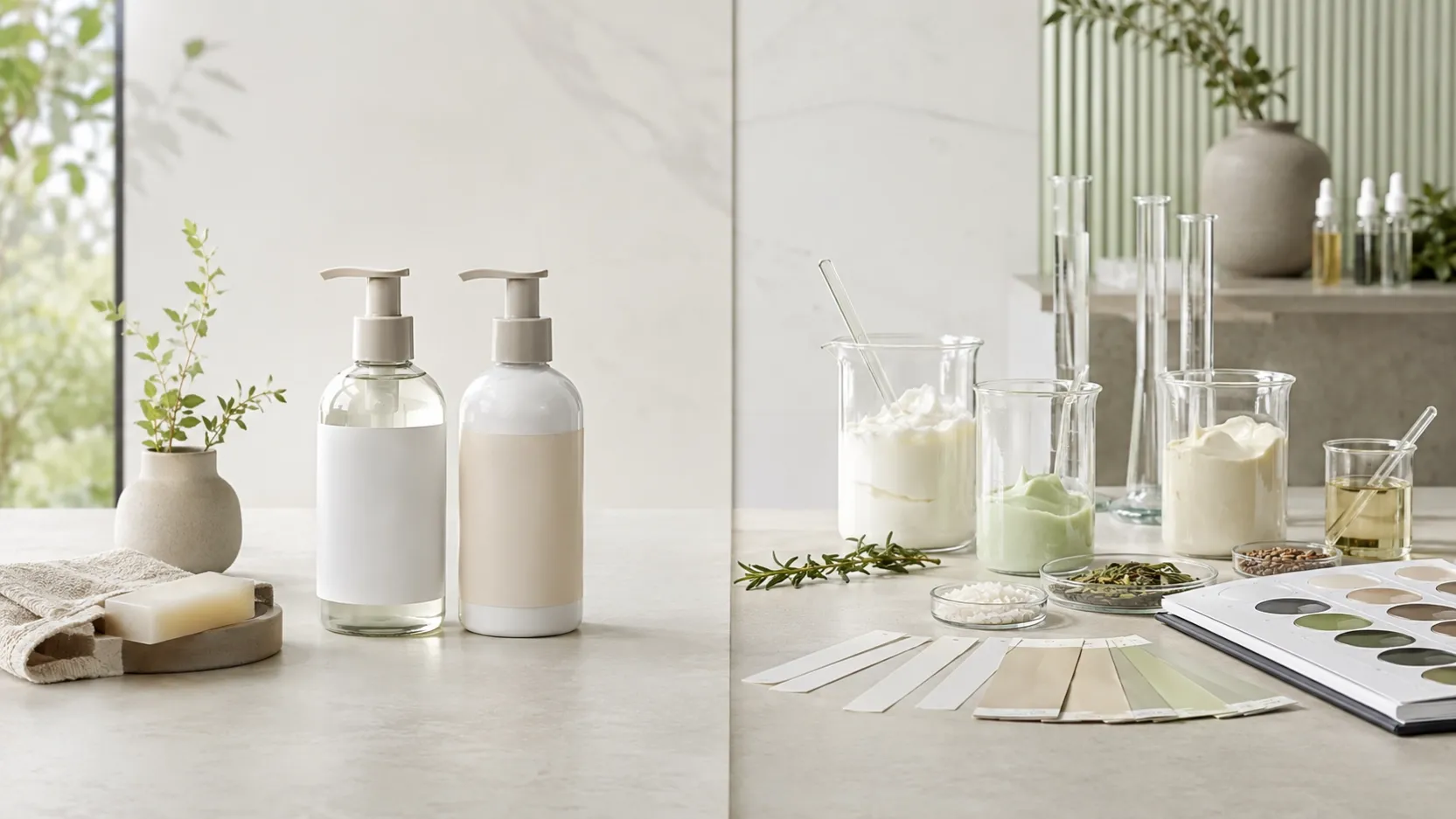
Private Label vs. Custom Formula: Which Option Is Right for Your Hair Care Brand?
The best development model is the one that matches your budget, launch speed, differentiation needs and proof of market demand.
The Wrong Development Model Can Waste Time and Cash
Many founders ask for a fully custom formula because it sounds more professional. Others choose the cheapest ready formula because they want to launch quickly. Both decisions can be wrong when they are made before the sales channel, budget and product strategy are clear.
A new e-commerce brand testing one hero product does not have the same needs as a distributor launching a salon range or an established brand replacing a current supplier. The development model should fit the commercial stage of the business.
What Is Ready-to-Label Private Label?
Ready-to-label private label uses an existing, production-ready formula. The brand selects a product, packaging option and label design, then launches it under its own name.
This route is usually appropriate when speed, lower entry quantity and market testing are more important than formula exclusivity.
- Best for first launches, channel tests and budget-controlled projects
- Usually offers the lowest development cost and shortest preparation time
- Works well with stock bottles, jars and standard label applications
- Allows the brand to focus resources on positioning, content and sales
The limitation is that other brands may use a similar base formula. Differentiation must come from product selection, fragrance, packaging, bundle design, brand story and channel execution.
What Is Semi-Custom Development?
Semi-custom development begins with an existing formula platform and adjusts selected characteristics. Depending on technical feasibility, these may include fragrance, color, viscosity, sensorial feel, selected ingredients or claim direction.
For many growing brands, this is the most practical middle ground. It creates a more ownable product without the full cost and timeline of development from zero.
- Best for brands that already understand their customer but still need cost control
- Supports clearer market differentiation than a standard ready formula
- Can coordinate several SKUs through one fragrance and visual system
- Requires sample approval and may require additional stability or compatibility review
What Is a Fully Custom Formula?
A fully custom formula is developed around a defined brief. The brief should specify target consumer, hair concern, benchmark, price range, texture, fragrance, ingredient direction, claims, packaging and applicable market requirements.
Full customization is most valuable when the brand has a validated market opportunity, a clear performance gap or a strong strategic need for exclusivity. It is not automatically the best choice for an untested concept.
- Best for established brands, validated concepts and distinctive hero products
- Provides the greatest control over sensorial profile and performance direction
- Requires clearer technical decisions, more samples and a longer timeline
- May involve higher MOQ, development fees and additional testing
The Five Factors That Should Decide
1. Proof of Demand
If the brand has not yet proven that customers want the product, a ready or semi-custom route limits the cost of learning. Full customization becomes more rational after customer feedback, repeat sales or a strong distributor commitment.
2. Differentiation
Not every product needs a unique formula. A shampoo-and-conditioner set can compete through fragrance, packaging, bundle architecture and a clear target customer. A hero repair treatment may require stronger formula differentiation.
3. Budget
Budget should include sampling, formula development, packaging, testing, labels, cartons, freight, registration, marketing and inventory—not only the filling price.
4. Speed
A market-ready formula can move into packaging and artwork more quickly. Custom work needs time for briefing, samples, revisions, compatibility and any required testing.
5. Scale
Custom bottles, decorations and formulas become more economical at larger volumes. Starting with flexible components allows the brand to protect cash flow while sales are uncertain.
A Smarter Two-Stage Launch Strategy
Many brands do not need to choose one route forever. A staged approach can reduce risk:
- Launch selected ready-to-label or semi-custom products with stock packaging.
- Measure conversion, reviews, complaints, repeat purchase and channel response.
- Identify which product deserves stronger formula or packaging differentiation.
- Upgrade the winning SKU or range during the next production stage.
This approach uses customer evidence to guide investment. It also reduces the chance of spending heavily on a concept that looks attractive internally but does not convert in the market.
How Junchun Cosmetic Structures the Options
Junchun Cosmetic supports market-ready formulas, selected semi-custom adjustments and full OEM/ODM development across shampoo, conditioner, hair masks, scalp care, hair oils, hair color and styling products.
Selected formulas and stock packaging options may start from 100 pieces per SKU. Higher quantities can apply to custom formulas, colors, fragrances, printed packaging or specially sourced components. Typical production is approximately 14–20 working days after formula, artwork, packaging and order details are approved; development and custom packaging time are separate.
Frequently Asked Questions
Is private label the same as OEM?
The terms are often used differently by suppliers. The important point is the actual scope: existing formula, adjusted formula or new formula, plus who supplies and controls the packaging.
Can I customize only the fragrance?
Often yes, depending on formula compatibility and quantity. Fragrance adjustment still requires sample confirmation and may affect cost or MOQ.
Will a custom formula be exclusive?
Exclusivity should be discussed and written into the commercial agreement. A custom development request does not automatically create unlimited exclusivity.
Which option is best for a startup?
Usually a ready-to-label or semi-custom option with stock packaging is the more controlled starting point. The final choice depends on budget, channel, positioning and proof of demand.
Not Sure Which Development Route Fits Your Brand? Share your target market, channel, budget, expected quantity and benchmark products. Junchun Cosmetic can recommend whether a ready formula, semi-custom option or fully custom development plan is commercially appropriate. |